
If I were to tell you that I have a doctor’s appointment next week, how do you visualize my doctor? Are they male or female? How old are they? What’s their ethnicity? Chances are that in our society that is dominated by White Supremacy, you visualized a white male doctor. Even if you didn’t, you cannot argue that whiteness is not the default in the United States.
As white people, we see ourselves represented in every form of media and, indeed, everywhere we go, because we’re usually out and among other white people when we shop, go out to eat, vacation, or visit the doctor. This also means that people in the United States who aren’t white also see white people represented in every form of media and everywhere they go. If you’re white and you’ve ever been mystified by any Black person stating that “representation matters,” that is exactly why. What does it mean to exist in a world where you never see anyone who looks like you modeled in media, toys, art, or professions? As white people, we find that difficult to fathom because it is so distant from our lived experience.
White Out of My Mind
White people never think about being white. We show up and inhabit the spaces we’re in. Sometimes we show up and just take over the spaces. It’s almost like colonization is in our collective consciousness. We can’t help ourselves. Or maybe we do just help ourselves. The point is, that for people who look like me, our skin color is rarely a consideration for our introspection or self-awareness anywhere we go. It’s not given a second (or first) thought.
When I was in seminary, I had the privilege of taking an anti-racism course specifically designed for white people. During one of the first sessions, we were asked to consider what it meant to be white in that space – or any space – we were inhabiting. In other words, to actually think about our whiteness. It was weird. I was still in a place that was controlled and fully inhabited by white people, but it differed because it was the first time I was ever mindful about my whiteness. I have been mindful ever since – especially when I am in spaces where anyone who is not white is present.
No nos Disculpamos
Right after I received my Master of Divinity degree, I had the privilege of participating in the Hispanic Summer Program (now the Hispanic Scholars Program) which was offered virtually that year because of the Pandemic. The program is designed for students of Latin and Hispanic heritage, but others are allowed to apply and awarded admission if there is space available. I was fortunate enough to gain a seat. Ordinarily, the program would have been in person at Union Theological Seminary in New York and provided an opportunity to spend time with other students and professors in person but we met via Zoom for the two-week program.
By the time I entered this program, I was already self-aware of my whiteness, but this was the first time I was in a space where I was a guest and I was in the minority. It was simultaneously an honor and disorienting. I was never uncomfortable, because the hosts of the program and my fellow students always made me feel comfortable and welcome, so it was far easier for me to lean into the honor and humility than into anything else. The most memorable thing for me, though, was during the opening convocation when the leaders announced that although the primary language being used by the instructors and in the classes for the program was English, participants were welcome to speak in Spanish at any time. It was made quite clear that translation would not be provided for the benefit of those of us who were not bilingual. No nos disculpamos – We’re not apologizing.
Black Church & No Control
Just last week, I traveled to Charlotte, NC to attend The Fellowship of Affirming Ministries (TFAM) Leadership Conference. My 78-year-old mother (who is also my housemate) traveled and attended with me, and I was joined by some other Columbus, OH colleagues at the event. TFAM was founded by Bishop Yvette Flunder, a name that is almost unknown among white people but one that Black churchgoers and gospel music aficionados know well, to provide an affirming space for Black queer Christians. Since its founding, TFAM has expanded into a radically inclusive organization welcoming people of all kinds who have been, for some reason or another, told they were “not enough” by the institutional religious and ecclesial bodies. I’ll likely write more about this in the future, but for now, I want to focus on a specific moment and experience we had in Charlotte.
When we arrived late for an evening worship service, there were only single seats available, so the folks from our Columbus cohort all sat separately. After we returned to our lodging, we were discussing how impactful the day had been, including the amazing worship experience. It was my mom’s first bona fide Black church experience and she was on a high! But something else made an impact on her: Where she sat.
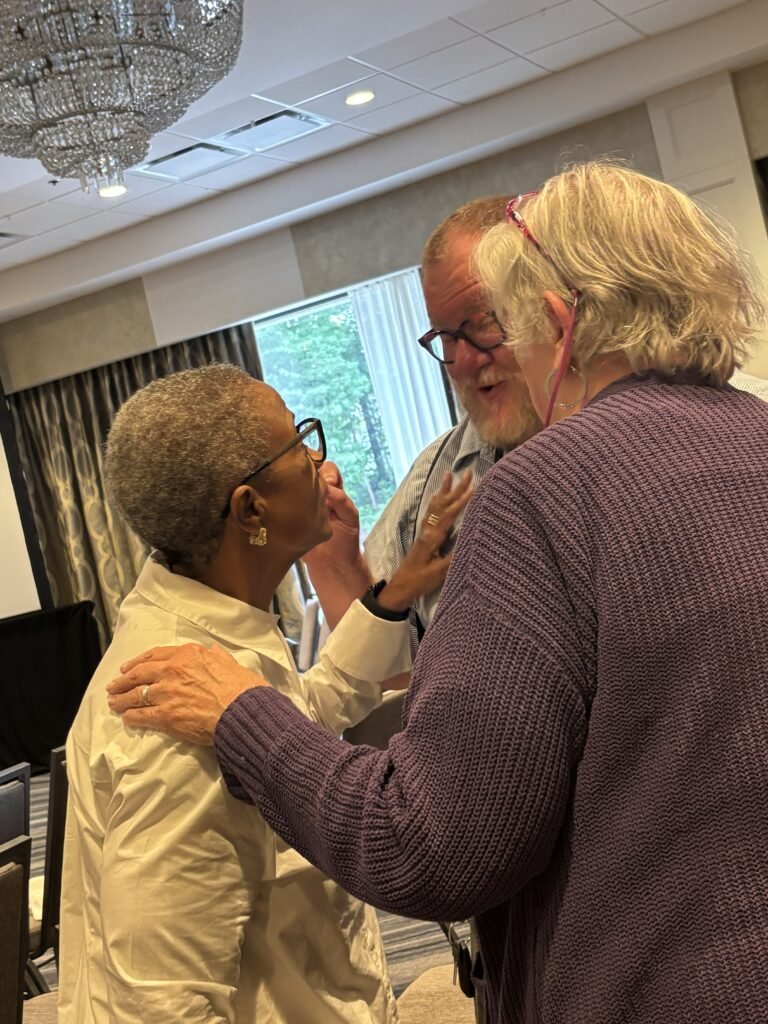
“When I sat down between two Black men on one side and a Black lady on the other, at first I felt a little bit uncomfortable. But I knew I was OK and safe because of where I was. And then I thought, ‘This must be what it feels like for Black people every time they have to come into a place and sit in a room full of white people. But they don’t know they’re safe.’ That never occurred to me before.”
White people are affected by White Supremacy. We are affected differently, to be sure, but affected nonetheless. This was a moment of liberation, epiphany, and even resurrection for my mom. These moments are not one-time occurrences, but because this was a first time for her, it will stick with her. I understand that. I feel that. My mom couldn’t stop talking about her experience and shared the story with Bishop Flunder, who listened with kindness and grace.
Out-of-Control White People
My mom and I weren’t the only white people at the TFAM event, though we were the only white people among our Columbus cohort, and there most certainly were more Black and brown people at the conference than there were white people. Being in the minority wasn’t a new experience in and of itself for either of us, and I don’t think it is for many white people, especially those who live in the South (we are from the Petersburg, VA area). What was markedly different for me during my HSP experience and for my mom at TFAM is that we were not just in the minority, but we were also in a space that was not controlled by white people. TFAM was founded by a queer Black woman and she made space for white people, we were guests. But not only were we treated like guests, we were welcomed as family. The warmth with which we were received was overwhelming.
I think that part of the reason white people are so afraid of the coming future when they are the minority and no longer in control of the United States is because they are afraid that Black and brown people are as vindictive, evil, and petty as white people are. That can’t be true, because if it were, we’d already have experienced a violent revolution, I think. Instead, it would seem to me that there is a recognition and understanding that the liberation of one requires the liberation of all.
Liberal white people have to become more accustomed to ceding power if true liberation is going to happen. I was going to say “sharing power” but I am unsure if we can be trusted to do that. Liberal white people are constantly getting in our own way (not to mention in the way of Black and brown people) in the struggle for liberation. Much of the reason why is that we can’t bear not having control.


I’m so glad you and your mom had a good time away. Well-written, as usual.