
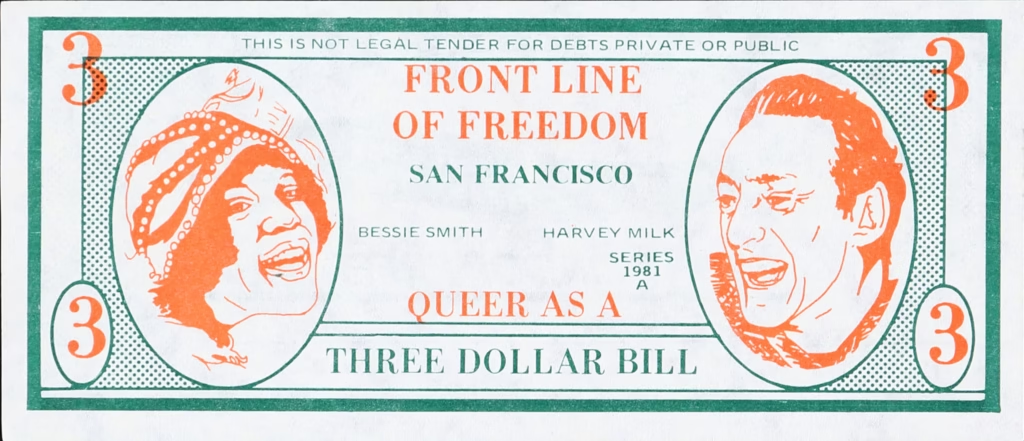
On the last day of Pride Month, the New York Times published “I’m Gay, Not Queer. That Matters,” by Matthew Vines, a free-to-read opinion piece. Vines is both quite famous and infamous, apparently, though as an old(er) gay exvangelical, I didn’t have much of an idea of who he was until I encountered him during a discussion in an Ethics of Sex course in seminary.
A Fruit Called Vines
If you’re reading this, then you’re not an idiot and you can search for things on the Internet, so I’m not going to take the time to talk much about Matthew Vines except to say he gained the spotlight first as an Evangelical teenager in Purity Culture claiming he was saving his first kiss for marriage. And then infamy in the Evangelical world by coming out and preaching about “clobber verses” in moderate Evangelical and Mainline churches. He’s white, cisgender, and from the Midwest. Perfectly palatable and perfect for writing this opinion piece at a time when tribalism among cisgender gay men seems to be on the rise. Matthew is just one of many former Conservative Evangelicals who has come to embrace their sexuality and reconcile it with their faith. That is absolutely not a bad thing. It’s a good thing, if you can do it, because it’s one of the most difficult things a non-heterosexual Conservative Christian would ever have to do. I spent a couple of decades apart from any sort of organized faith tradition because who I knew myself to be did not match who I was told to believe I was supposed to be. And those are two very different things.
In Vines’ essay, he laments how the label “Queer” has essentially expanded the field of who is included in the LGBT+ community and therefore diluted the cause and focus on equal rights. He has boiled it down to respectability. I’m not sure who is going to tell him, but after the masked dudes on the DC Metro are done with all the nonconformists, they’re coming for the “pick me” gays like Matthew and the ones in the Trump Administration who think their proximity to power, whiteness, and respectability will somehow make up for the fact that they like to have sex with other men.
Evolution & Revolution
In the movement for Gay Liberation, “We’re Here, We’re Queer, Get Used to It!” was a popular phrase precisely because it sought to take back the power of a word that had been hurled as an insult at people and use it as a label of pride. And, of course, just like any other movement, there were folks calling for moderation and civility and that using that sort of language didn’t help the cause. I get that. It’s in my nature to stay inside boundaries and not rock the boat.
I was born in 1974 and I’m right on the cusp of the generation of LGBT folks who were targeted with “queer” as a slur. I don’t have the same visceral knee jerk reaction to it that some of my elders do and that has made my evolution on this journey a little easier, I realize. I also know that language evolves, whether we want it to or not. Words and meanings of words change with societal usage and norms. “Queer” shows up an awful lot in Alice in Wonderland for example, and it never once refers to anyone who is homosexual or outside of any sort of sexual or gender norm.
Q Gets Around
If you’re familiar at all with chess, then you know that the Queen is the most versatile and powerful piece on the board. She is able to travel any direction and for any length of the board. The Queen has total freedom and reign over the playing field in the game.
Much like the Queen in chess, the Q in LGBTQIA+ is able to go all over and help give a word for people to use for things they can’t yet quite describe or to bridge gaps between identities. Queer is a very versatile, powerful, and accepting word. A few years ago when I realized I identify on the asexual spectrum as well as being gay, queer became a great label that felt natural for me to use that encompassed my full identity, including ones that I may not have discovered yet.
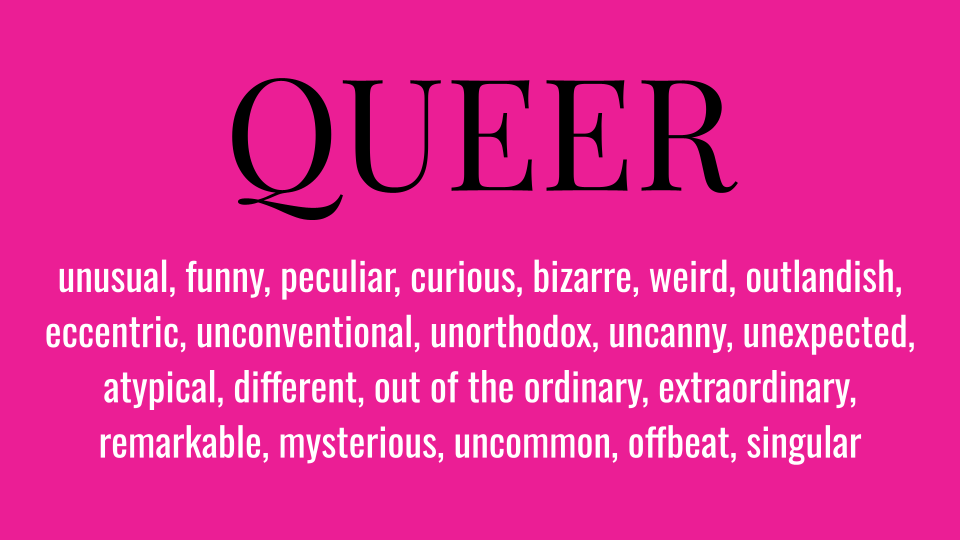
A few years ago when prepping for a Pride Sunday sermon, I looked up Queer in a thesaurus and what I found endeared me even more to the label and made me decide that I want to be proudly queer. Take a look:
Queer is Authentic
It is clear that acceptance from the mainstream of society – both religious and secular – is important to Vines. As a cisgender white male, he pretty much already has the secular mainstream acceptance, or at least the appearance of it. It is that appearance of acceptance that has lulled Vines into a false sense of security. He knows that LGBTQ+ rights are in danger in this country and instead of deciding to stand in solidarity with others who are oppressed, he says, “I’m one of the ‘normal’ ones and if you don’t behave, we’re all going to lose.”
It strikes me that the issue people like Vines take with queerness somehow creating spaces that are “too affirming” and “too open” (what even does that mean?) is really that queerness creates spaces where people can exist as their authentic selves. And if there is anything that conformity doesn’t like, it’s authenticity. Conformity leads to seeing everything the same way. It makes it easier for people to be controlled.
Queerness is Next to Godliness
Is it really? I don’t know. Maybe? I think about a cross stitch artwork that was in my room when I was a kid: “I know I’m special because God don’t make no junk,” it read. I mean, I think about the diversity of the universe, nature, people, thought, art, even religion. If God or something divine-like had a hand in all of it, it certainly seems like they like things nice and queer. Eccentric. Peculiar. Uncanny. All of that stuff. So I’ll be Gay and I’ll be Queer. Because it matters.



I read this piece too, and it made me think of how two of my mother’s sisters are gay, but it was never something that was addressed with me as a kid. Whenever we would talk about them, my parents would refer to their companions as “friends” or “roommates.” I was finally able to figure it out for myself, but the closest I ever came to getting the truth out of my parents was after the Obergfell decision, when I wrote a coded post about them on FB (no real names), and my dad fired off an email to me that I should take it down because he didn’t want my aunts to get in any troubles. Which I guess is a roundabout way of saying that assimilationism has always felt like an older-generation thing. The fact the someone born in the 1990s is still out there discussing it is pretty gross to me.